
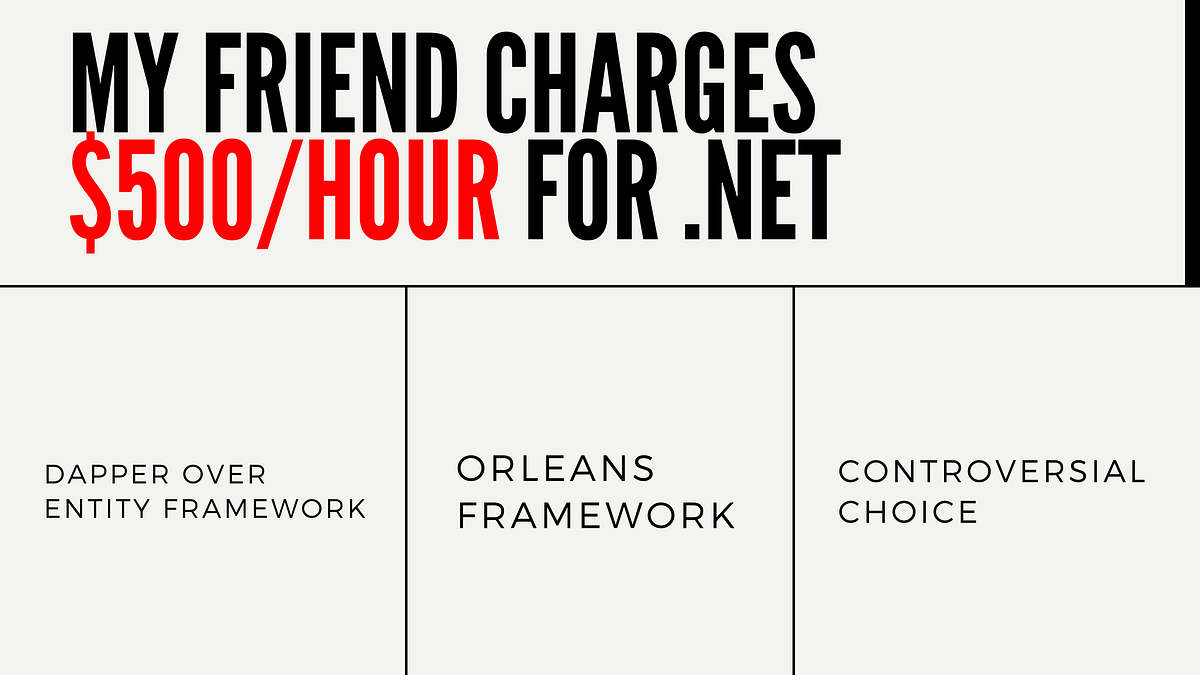
I recently came across a .NET consultant’s rate card, and while checking that, I was shocked to know
— $500 per hour
That’s $4,000 for a single day’s work!! Dammm….
While most senior developers earn this in a week, this consultant commands it in eight hours. After investigating his approach and technology choices, I found the actual reason why companies willingly pay this premium rate… (sharing with you guys..)
✔️Reality Check
IT consulting rates in 2025 vary dramatically across regions and specializations.
United States — $100 to $400 per hour, with specialized consultants in finance or healthcare commanding premium rates at the upper end of this spectrum.
$500/hour— consultants who deliver transformational results for critical systems…
🔺So What was His Exact Technology Stack 🔺
Dapper Over Entity Framework
The consultant exclusively uses Dapper for data access, completely avoiding Entity Framework Core. Dapper has a reputation for being one of the fastest micro-ORMs available for .NET. It provides significant performance gains over Entity Framework, especially when large amounts of data are queried.
I was using EF core for a long but that ‘Include’ shit! I hate that tbh…
Here’s why this matters in financial systems —
// Entity Framework query - average execution time: 45ms
var orders = await context.Orders
    .Include(o => o.OrderItems)
    .ThenInclude(i => i.Product)
    .Where(o => o.CustomerId == customerId)
    .ToListAsync();

// Dapper equivalent - average execution time: 8ms
var sql = @"
    SELECT o.*, oi.*, p.*
    FROM Orders o
    LEFT JOIN OrderItems oi ON o.Id = oi.OrderId
    LEFT JOIN Products p ON oi.ProductId = p.Id
    WHERE o.CustomerId = @customerId";

var orders = await connection.QueryAsync(
    sql,
    (order, item, product) => {
        // Manual mapping logic
        return order;
    },
    new { customerId }
);
Dapper’s minimal abstraction and direct SQL execution allow it to process queries up to 5–10x faster than EF Core.
By bypassing ORM layers like entity tracking and LINQ translation, it provides low-latency performance, making it the top choice for real-time analytics, dashboards, and performance-critical applications…
Orleans Framework
He told me that for distributed computing, he uses Microsoft Orleans exclusively. Orleans is often referred to as “Distributed .NET” because of its focus on building resilient, scalable cloud-native services. Microsoft uses Orleans in Azure, Xbox, Skype, Halo, PlayFab, Gears of War, and many other internal services.
before meeting him I thought Orleans is just for a gaming environment and a project.. but he made me doubt.
But the framework is particularly useful for financial software development, as it offers a way to manually configure reentrancy with method decorators, keeping data consistent without dealing with optimistic concurrency or distributed lock providers.
Redis
His strategy includes using Redis for everything.. Every read operation goes through Redis first!
SignalR
For trading platforms and real-time dashboards, he implements **SignalR **with custom backplanes optimized for financial data
🔺Controversial Choice🔺
No Docker
He deploys directly to VMs or Azure App Service, claiming container overhead isn’t worth it for financial systems.
Blazor Server over WebAssembly
Lower latency for trading interfaces, despite the server dependency…
No Unit Tests
Only integration tests that validate actual database queries and distributed transactions.
No Microservices Under 1M Daily Transactions
Advocates for modular monoliths until proven scale requirements.
His Specialization
His main job is on modernizing legacy trading and banking systems. Freelance IT consultants working in finance might demand rates of $200 to $400 per hour due to the complexity of financial systems and the stringent security requirements. His $500/hour rate reflects the upper echelon of this specialization…
Engagement Pattern
3-month minimum contracts
20 hours per week maximum
Architecture and critical path implementation only
Knowledge transfer included in rate
I asked for RULES —
He said:
- Every technical decision must tie to business metrics.
- Only architecture and performance optimization.
- Including email responses and code reviews.
- Performance benchmarks before and after every change.
- The team must maintain the system (KT) after departure.
🔺My Notes after Meeting🔺
Skills
**.NET Internals — **Understanding memory management, garbage collection tuning, and runtime optimization.
**SQL — **complex queries that execute in milliseconds, not seconds.
**Distributed Systems Expertise — **Handling eventual consistency, partition tolerance, and distributed transactions.
**Financial Domain Knowledge — **Understanding trading systems, risk calculations, and regulatory requirements.
**Performance Profiling — **Using tools like BenchmarkDotNet, PerfView, and custom telemetry.
When a trading system processes millions of dollars per minute, a 100ms improvement in latency can translate to millions in additional revenue. The $500/hour rate becomes insignificant compared to the value delivered.
Performance Over Convenience
While EF Core reduces the need for manual SQL, improper DbContext management can lead to performance issues. By choosing Dapper, he maintains complete control over every query, ensuring optimal performance for financial calculations.
Proven Over Trendy
Orleans has been already tested and using by Microsoft in production since 2011. Redis has proven reliability. SignalR handles millions of concurrent connections. Every technology choice prioritizes stability and performance over developer convenience.
Simplicity at Scale
Rather than complex microservice orchestration, he builds modular monoliths that can be split when necessary. This approach reduces operational complexity while maintaining flexibility.
choose technologies based on measurable performance, specialize in complex domains, and always tie technical decisions to business value